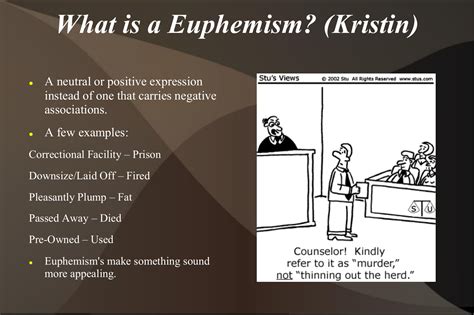
I was recently recalling a story about a friend o mine, from Chile. He is a well educated and very personable. At the time we began to become friendly, he had only lived in our country about three years and although his english was excellent, he described how difficult it was for him to ubferstand the various ways we expressed ourselves. For him, english was a mish-mash of words and phrases thar had kittle or nothing to do with whatever the subject was being discussed. One example he gave, he had read in the newspaper that some important person had passed away. It took him a couple of moments to realize the author was referring to the persons death.
This began a years-long conversation concerning how to say what we means so as not to obfuscate the meaning of what was being said. I had to agree that we often soften our language ; language which is more shocking, or brutal than that which is substituted. Consider how often we hear “passed away” versus “died”. What does the former really refer to and what is it’s origin. A little research discovered it’s first known use was in the 13th century and was meant as a more polite way to say died. I’m sure there’s more to it but I’m not writing my thesis on euphemisms. Yes, that’s what this post is about.
Another euphemism I find inexorably tiresome is the use of sleeping, in it’s various forms, to sex. “John and Joan are sleeping together” is supposed to be a polite way of saying that these two are having sex together. In “sleeping together” , we assume some sort of bedroom scene where we couldn’t saying “John bent Joan over the couch and had sex with her.” So we make the act less personal by imaging all sex to occur in a bed in which, afterwords the two fall asleep in each others arms. How sweet. Instead of picturing the same in the shower, on the rug, car back seat…sleeping?
How often do we use euphemisms so as not to offend another person? How has “died” or “sex” less meaningful ? Going back to my friend when he was a fairly new immigrant: we use euphemisms often and to some not so familiar with the language, these can make communication tricky. I think that instead of offending the hearer, sometimes its easier on the speaker to use less blunt terminology whether or not it truly expresses any meaning whatsoever. Does passed help the grief stricken anymore than died? I don’t brlieve so but in other ways applying a euphemism may make a situation more palatable to a wider audience.
Rhere are euphemisms for everything, like going to thr restroom(itself a euphemism) instead of announcing you have to urinate or pee. Almost anything we do daily may be exptrdded euphemistically. I think I’m going to attempt to count the number of times I use a euphenism during the day. I woder how long it will take me to resign in failutr?
 Conservative Skeptic